

In this spyglass article:
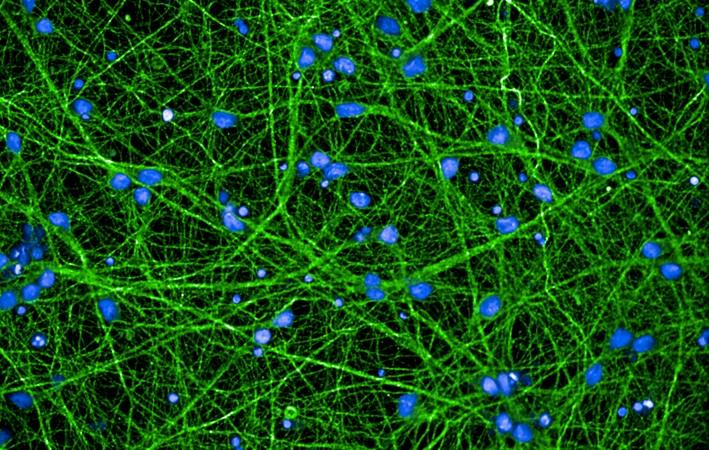
Picture of iPSC-dopaneurons (FUJIFILM Cellular Dynamics) stained with b-II tubulin (neurons and neurites-green) and Hoechst for nuclei (blue) – representative of a single fov of a 384-well.

Find this article interesting? Download our webinar to discover more about how our α-synuclein assay platform supports Parkinson’s disease programs.
Neurodegenerative diseases such as Parkinson’s disease (PD), Alzheimer’s disease, amyotrophic lateral sclerosis (ALS), and frontotemporal dementia are characterized by progressive neuronal dysfunction associated with protein aggregation and organelle dysfunction.
Among the proteins involved, α-synuclein (α-syn) has emerged as a central driver of Parkinson’s disease. Under physiological conditions, α-synuclein plays a role in synaptic vesicle trafficking and neurotransmitter release. However, pathological misfolding leads to toxic oligomers and fibrillar aggregates that accumulate in Lewy bodies and contribute to neuronal degeneration1.
Increasing evidence highlights the role of cellular organelles in regulating protein homeostasis, particularly:
These systems maintain cellular proteostasis and prevent accumulation of misfolded proteins. In Parkinson’s disease, dysfunction of these organelles, especially lysosomal impairment, strongly contributes to α-synuclein aggregation and toxicity2. Consequently, targeting pathways involved in lysosomal function, autophagy, and protein clearance has become a promising therapeutic strategy.
Despite strong biological rationale, a major limitation remains the lack of robust and physiologically relevant cellular assays capable of modeling α-synuclein aggregation and its modulation by pharmacological compounds.
Traditional biochemical assays detect fibril formation in-vitro but fail to capture the complexity of cellular environments influencing aggregation, trafficking, and clearance. Conversely, many cellular models rely on overexpression systems, often leading to non-physiological phenotypes. This creates a gap between early screening assays and disease-relevant biology, slowing the identification of effective drug candidates.
Next generation assays are therefore required to:
Advanced phenotypic and functional assays combined with disease-relevant cell systems allow the development of multiparametric cellular platforms capable of capturing the complexity of neurodegenerative processes.
To support Parkinson’s disease drug discovery efforts targeting α-synuclein, Axxam has developed an integrated cellular workflow capturing multiple aspects of Parkinson’s disease biology in human systems.
The workflow includes high-content imaging assays that enable visualization and quantification of α-synuclein aggregation in human cells. These assays provide robust and scalable ways to monitor how α-synuclein accumulates and how candidate compounds may influence this process.
To increase physiological relevance, aggregation analysis can be extended to human iPSC-derived dopaminergic neurons, the neuronal population most affected in Parkinson’s disease. Studying α-synuclein pathology in these cells enables evaluation of therapeutic strategies in a context that more closely reflects human disease biology.
However, Parkinson’s disease involves more than neuronal dysfunction alone. Increasing evidence highlights the important role of astrocytes and other glial cells in regulating neuronal health and maintaining proteostasis in the brain. Astrocytes contribute to protein clearance pathways and may influence the propagation or removal of pathological α-synuclein species. Incorporating these cellular interactions is therefore essential for understanding disease mechanisms and identifying effective therapeutic interventions.
Beyond protein aggregation itself, Axxam’s platform also explores cellular pathways that regulate proteostasis and organelle function, particularly lysosomal activity and mitochondria responsible for maintaining protein homeostasis.
This platform enhances profiling of disease phenotypes by also integrating Cell Painting, a high-content image-based profiling technique, which enables automated, quantitative analysis of organelle morphology, cellular and neurite network structures providing a holistic view of the model.
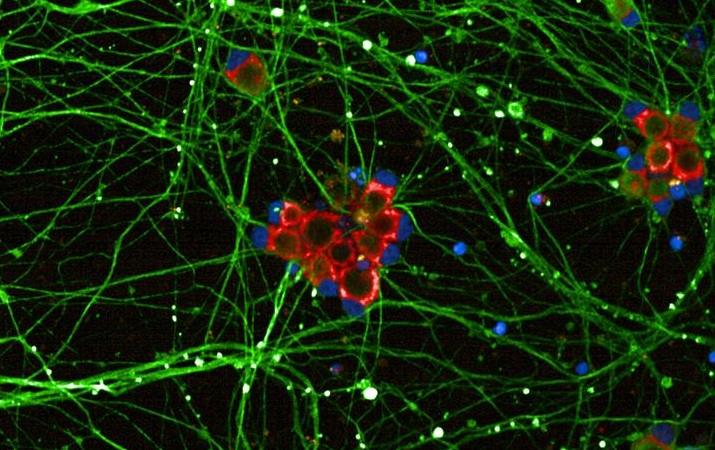
Cell Painting on FUJIFILM Cellular Dynamics iPSC-derived neurons.
Functional cellular assays are complemented by electrophysiological approaches that provide direct insights into neuronal and organelle physiology. Multielectrode array (MEA) recordings allow the monitoring of neuronal network activity in dopaminergic neuron cultures, revealing how disease mechanisms or pharmacological interventions affect neuronal communication. Electrophysiological recordings from isolated lysosomes enable the investigation of ion channel activity within lysosomal membranes, an emerging area of interest in Parkinson’s disease biology.
By integrating these complementary layers of information, the platform connects:
This integrated approach moves beyond single-endpoint assays and provides a broader and more mechanistic view of Parkinson’s disease biology, supporting target validation, mechanism-of-action studies, and compound screening in physiologically relevant systems.
An integrated and multiparametric assay platform, such as the one we developed at Axxam, offers new opportunities to bridge the gap between target biology and therapeutic discovery.
By combining:
researchers can gain deeper insight into disease mechanisms and compound activity.
α-Synuclein and Organelles: Key Players in the Neurodegeneration Puzzle
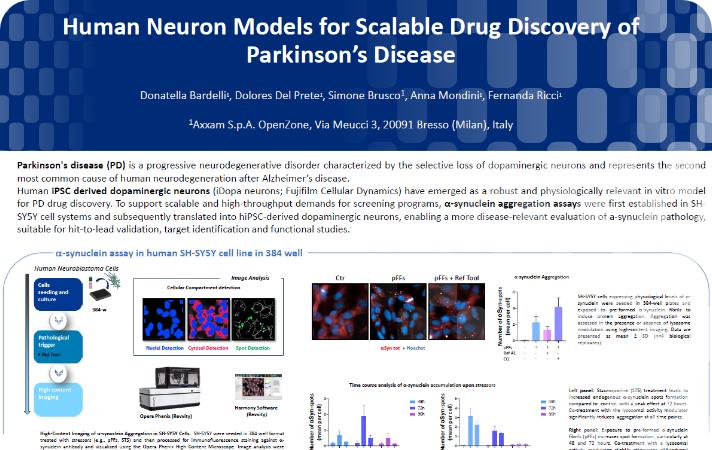
Human neuron models for scalable drug discovery of Parkinson’s disease
α-synuclein aggregation assays enabling disease-relevant evaluation for hit-to-lead validation, target identification, and functional studies
What are α-synuclein assays? α-synuclein assays are cellular models used to measure protein aggregation, toxicity, and modulation by compounds in Parkinson’s disease research. At Axxam, these assays are implemented in physiologically relevant human cell models to enable drug discovery applications.
Why are iPSC neurons important in Parkinson’s research? They provide human-relevant models of dopaminergic neurons, enabling more predictive evaluation of drug candidates.
How do lysosomes influence α-synuclein aggregation? Lysosomes regulate protein degradation. Their dysfunction leads to impaired clearance and accumulation of α-synuclein aggregates.
