


NAMs & Early Drug Discovery Derisking
Bridging biology and translational confidence across early drug discovery
Most drug development failures trace back to decisions made at the earliest stages of the pipeline: insufficient translational relevance, undetected safety signals, and poor compound physicochemical properties.
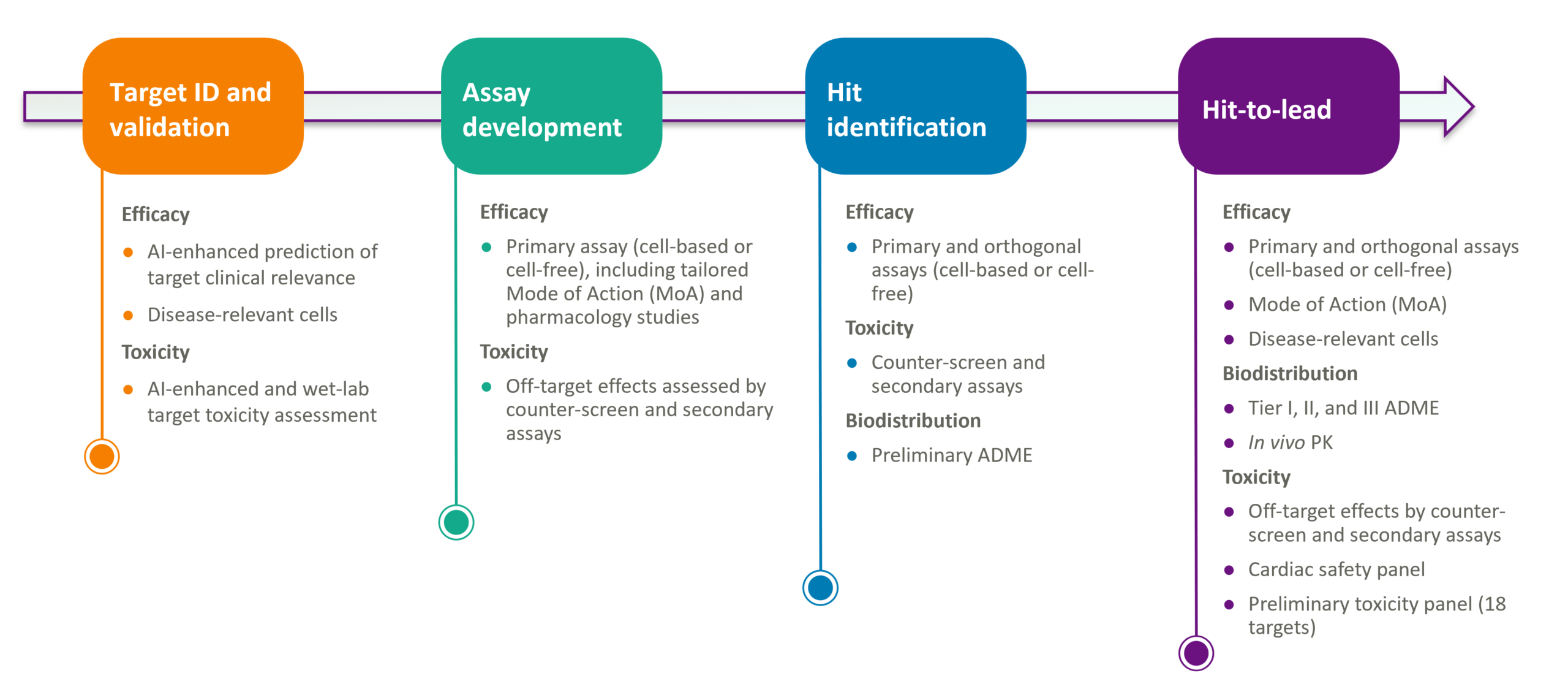
Axxam’s DiscoveryMAXX workflow integrates NAMs and early derisking strategies to address this challenge, combining human-relevant biology, in chemico profiling, computational intelligence, and biomarker readouts into a coordinated framework that progressively builds evidence from the first hypothesis to lead candidate.With translationally predictive assays spanning efficacy, toxicity and biodistribution,
Axxam de-risks your program from the start and lowers downstream candidate attrition
What are NAMs and why do they matter?
New Approach Methodologies (NAMs) are non-animal methods designed to generate mechanistically grounded, human-relevant data for safety and efficacy assessment, encompassing a range of complementary in vitro, in chemico, and in silico approaches.
Rooted in the 3Rs principles of Replacement, Reduction and Refinement, NAMs are gaining increasing regulatory relevance. This transition is reflected in the FDA Roadmap to Reducing Animal Testing in Preclinical Safety Studies, which promotes the adoption of scientifically validated, human-relevant approaches to progressively reduce reliance on animal testing and improve the predictive relevance of preclinical drug development.
Species differences in pharmacokinetics, receptor pharmacology, and off-target profiles have contributed to numerous preclinical-to-clinical failures. By anchoring programs in human-derived cellular models, physiologically relevant 3D systems, and AI/ML-assisted mechanistic computational tools, Axxam helps clients generate data that travels from bench to clinic with interpretable confidence.
1. In vitro 3D biology and human-relevant cell models
Axxam’s in vitro platform spans the full spectrum of cell model types: immortalized lines, primary human cells, and iPSC-derived cells representing disease-relevant genotypes. For advanced biology, the platform includes organoids, microtissues, and organ-on-chip (OoC) systems, capturing emergent properties (e.g., tissue architecture, network-level phenotypes, and paracrine communication) that are inaccessible in conventional 2D systems.
Assay capabilities across these models include cell-based and cell-free formats, high-content imaging and Cell Painting, electrophysiology (automated and manual patch-clamp, organellar electrophysiology, and MEA), omics readouts, and genome engineering via CRISPR. This breadth allows assay cascades to be designed around each program’s specific pharmacological and safety questions, mechanistically anchored and pathway-informed from the outset.
2. In chemico derisking: ADME and MedChem
Even the most potent molecule will fail if it cannot reach its target or raises safety liabilities that preclude clinical progression. Axxam’s in chemico derisking addresses these issues before hit declaration through integrated analytical chemistry and in vitro ADME profiling, covering physicochemical properties, metabolic stability, and membrane permeability, which enables data-driven hit prioritization. Medicinal chemistry support is embedded directly in the early discovery workflow.
Through close collaboration between Axxam and Symeres, medicinal chemistry expertise is seamlessly extended from hit identification through hit-to-lead and lead optimization, ensuring continuity across the entire discovery process up to preclinical candidate selection. This integrated setup enables a fully aligned derisking strategy, combining iterative SAR analysis, tiered ADME, analogue design, and chemical matter quality assessment. The result is a tight feedback loop between interdisciplinary data and chemical hypothesis generation, accelerating the progression of high-quality series toward optimized lead candidates.
3. In silico and computational derisking
Computational capabilities are embedded as an integrated layer within DiscoveryMAXX, combining AI-driven clinical-target intelligence with rigorous biological validation. The platform curates and structures molecular, phenotypic, and clinical data from public and private datasets to generate causal, actionable insights across the early discovery path. These capabilities include:
- Target identification and validation: AI-driven analysis of complex biomedical datasets to identify novel, high-potential drug targets, with computational predictions directly linked to experimental validation workflows.
- Indication and biomarker discovery: Identification of disease-relevant molecular signatures and patient stratification opportunities to inform target selection and program focus.
- Molecular disease subtyping: Investigation of disease subtypes and responder populations, supporting precision medicine approaches from the earliest stages of discovery.
- Safety prediction: Clinical data-informed risk anticipation to flag candidate liabilities before experimental testing.
- Real-World Data (RWD) analytics: Integration of real-world evidence to ground target hypotheses in clinically observed and phenotypic data.
- Interactome and multi-omics integration: Network-level target contextualization via protein-protein interaction maps, pathway analysis, and multi-omics data integration.
New drug modalities and compound collections
Our platforms are well suited to a broad range of current and emerging therapeutic modalitie: small molecules (including targeted protein degraders and molecular glues), nucleic acids (ASOs, siRNA, mRNA), peptides, enzymes, antibodies/nanobodies, and gene therapy vectors. Across all modalities, assay design is tailored to the specific pharmacological and biophysical properties of each therapeutic class, ensuring scientifically appropriate, fit-for-purpose profiling.
Axxam’s compound collections span a broad and distinctive chemical space, comprising a diversity-oriented deck of physical and virtual compounds, complemented by focused subsets of pure natural products, covalent compounds, RNA-targeted molecules, protein-protein interaction inhibitors, and macrocycles. The collections are assembled and curated with input from Axxam’s medicinal and computational chemistry teams. Focused and customizable virtual subsets can be defined for specific target classes or screening strategies, ensuring hit diversity, synthetic tractability, and high novelty across programs.
Biomarker capabilities
Translating biological activity into clinically relevant signals requires robust biomarker strategies. Axxam supports biomarker measurement and development across multiple platforms: transcriptomics for pathway engagement profiling; AlphaLISA, ELISA, HTRF, and multiplexed Meso Scale Discovery (MSD) immunoassays for quantification of cytokines and signaling proteins; and high-content Cell Painting for unbiased morphological profiling. Altogether, these platforms generate compound fingerprints that can be mined for mechanism-of-action prediction, toxicity clustering, and phenotypic similarity analysis.
A structured path to translational confidence
Axxam’s NAM & Early Derisking framework is a coordinated, program-specific strategy, not a menu of disconnected services:
- Relevant in vitro 2D and 3D models and organ-on-chip approaches interrogate efficacy and safety in human-relevant systems.
- In chemico profiling addresses pharmacokinetic liabilities early. Biomarker readouts connect cellular phenotypes to translational context, while MedChem expertise continuously links chemical matter to biological outcomes.
- In silico tools frame the biological question.
The result is an early drug discovery program that advances with evidence, not assumptions, supported by a scientific team that acts as a true partner throughout the translational journey.
Interested in building a NAM-aligned derisking strategy for your program? Contact us to discuss how Axxam can support your early drug discovery pipeline.
FAQ
What are NAMs in drug discovery?
New Approach Methodologies (NAMs) are non-animal methods designed to generate mechanistically grounded, human-relevant data for safety and efficacy assessment. They encompass complementary in vitro, in chemico, and in silico approaches, including human-derived cellular models, advanced 3D systems, organ-on-chip technologies, chemical and biochemical profiling, and computational methods that can improve the translational relevance of early drug discovery.
How can NAMs help derisk early drug discovery?
NAMs can help derisk early drug discovery by identifying efficacy, safety, and translational risks earlier in the discovery process. By combining human-relevant biological models with in silico approaches, in chemico profiling, and biomarker readouts, potential liabilities can be investigated before compounds progress to later and more resource-intensive stages.
Which human-relevant models does Axxam use?
Axxam works with a broad range of human-relevant in vitro models, including primary human cells, iPSC-derived cells, organoids, microtissues, and organ-on-chip systems. These models can be combined with technologies such as high-content imaging, Cell Painting, electrophysiology, MEA, omics readouts, and CRISPR genome engineering.
How does Axxam integrate NAMs into drug discovery programs?
Axxam integrates NAMs within DiscoveryMAXX, its coordinated, program-specific approach to early drug discovery and derisking. In silico approaches help frame biological questions and identify potential risks, while human-relevant in vitro models investigate efficacy and safety. In chemico and ADME profiling assess compound liabilities, while biomarker and medicinal chemistry capabilities connect biological findings with compound optimization, helping build translational confidence throughout the discovery process.