

AXXAM

Science Spyglass

Why do GPCRs continue to dominate drug discovery?

A central drug discovery target class.

GPCRs sit at the centre of human physiology and remain among the most druggable proteins we have.

516

approved drugs target GPCRs — about 36% of all medicines

121

distinct GPCR targets already addressed by approved drugs

151

GPCR targets currently in clinical trials

Central to
human physiology
and highly
druggable targets

*Nature Reviews Drug Discovery, Volume 214, June 2025, 458-479

Strong relevance across multiple therapeutic areas

Axxam capabilities.

Axxam delivers integrated GPCR discovery solutions.

Translating complex GPCR biology into actionable drug discovery insights.

Receptor expertise

~80

Human GPCR targets, several assays already available for clients

~400

odorant receptors + TAS1R (sweet/umami) + TAS2R (bitter)

Functional assays

HTS- and compound testing-ready assays for:

  • Agonists
  • Antagonists
  • PAMs
Functional readouts
  • AMP (Gs/Gi) — HTRF, GloSensor, CNG
  • Ca²⁺ (Gq) — GCaMP, dye-based assays, IP1-HTRF
  • β-arrestin — NanoBiT, PathHunter®

The Critical Importance of GPCR Functional Assays in Drug Discovery Projects

Explore how GPCR functional assays and in vitro pharmacology can help characterize drug candidates beyond potency, predict their activity across biological systems, and identify potential safety and ADME limitations early in drug discovery.

    Designing the right assays to identify GPCR hits.

    Every GPCR routes its signal through one or more of three main functional pathways. Reading the right one is what turns a screen into usable pharmacology.

    1. Confirm biological activity

    Is the activity real? A functional readout separates genuine target engagement from assay noise.

    2. Identify the signaling pathway

    Which pathway is being activated? Matching the assay to the receptor’s native coupling matters.

    3. Prioritize the best candidate

    Which hit should move forward? Functional data ranks candidates on more than potency alone..

    Beyond the hit.

    Finding GPCR hits isn't the hardest part. Understanding them is.

    A confirmed hit still leaves open how it behaves at the receptor. These five characterizations fill in that picture.

    Schild

    analysis

    Biased signaling

    Residence time

    PAM
    characterization

    Kd determination

    Putting it together.

    From complex GPCR biology to confident drug discovery decisions

    Functional assay development

    Pharmacological characterization

    Hit-to-lead support

    End-to-end expertise to de-risk and accelerate GPCR programs

    Let's discuss your GPCR discovery project

    Bring us your target, your hits, or your toughest GPCR question.
    We’ll help you build the assay strategy to investigate it.

    From assay development to compound characterization:

    • Develop robust functional assays
    • Screen agonists, antagonists and PAMs
    • Characterize compounds beyond potency
    • Generate data for confident decisions

    Have a GPCR challenge in mind? Tell us about your target, compounds or assay needs.
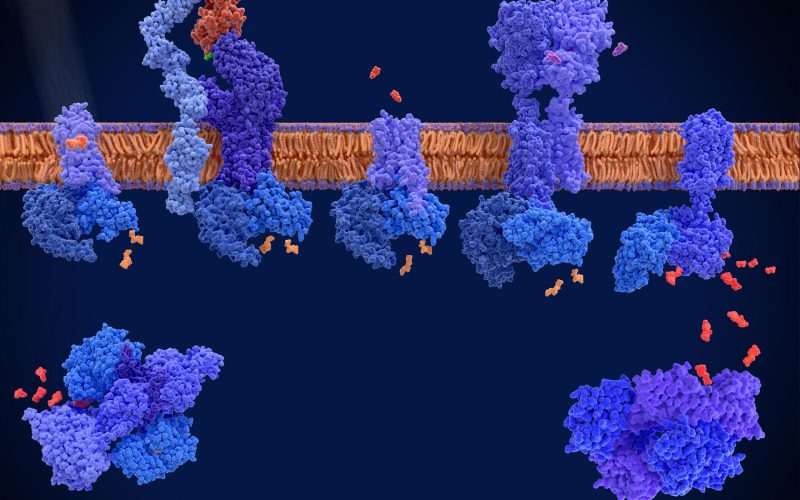
    G-protein-coupled receptors (GPCRs) have central roles in intercellular communication. From left to right, Rhodopsin activated by light, T-cell receptor activated by MHC and antigen (green), dopamine receptor activated by dopamine (red), GABA B receptor activated by the agonist baclofen. G alpha proteins (light blue) activate the phosphodiesterase 6 (left), which degrades cGMP, and  adenylyl cyclase (right), which produces cAMP.  cAMP activates the protein kinase C. Source: PDB entries 6oy9, 7aue, 1jl4,  1fyt,  7eb2, 6r3q, 3tnp, 7jsn
    Scroll to Top