



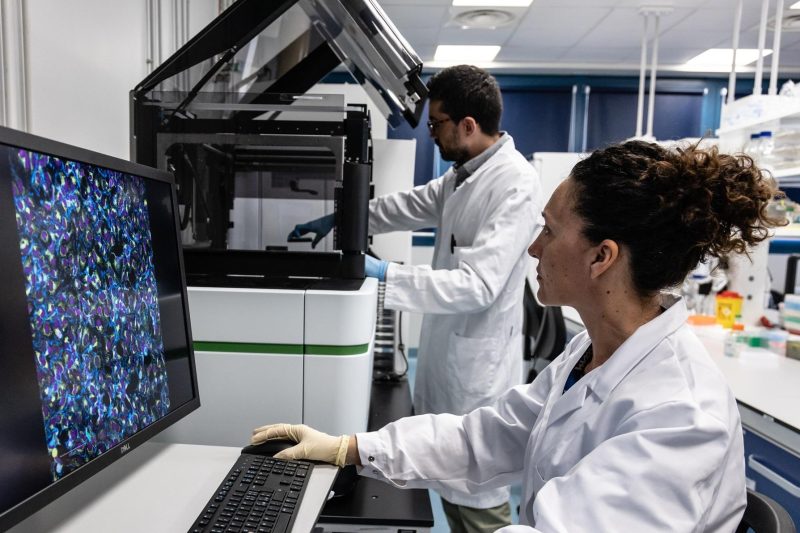
We routinely run automated screening campaigns with either cell-free or cell-based assays (homogeneous and non-homogeneous) in both high-throughput screening (384 well plate) and ultra-high-throughput screening (1536 well plate) format:

For projects targeting ion channels or electrogenic proteins, our clients can rely on high quality patch-clamp screenings run on the SyncroPatch instrument (Nanion) integrated in a fully automated robotic platform. Beyond primary screenings on a large compound collection, this instrumentation can be used for:
- Clone selection
- Compound profiling
- Hit validation/structure–activity relationship (SAR) studies
The integration of TaqManTM RT-qPCR readers in automated systems enables us to study drug-induced changes in gene expression directly in relevant cells types.
- Suitable for any cell type or target gene
- Close to physiological conditions
- Multiplexing: up to 3 different genes/labels can be monitored simultaneously (including housekeeping genes as reference)
- Appropriate primer selection allows RNA splicing to be followed quantitatively
The imaging of cellular structures and function in live or fixed cells using automated fluorescence microscopy offers another option to study the impact of drugs on relevant phenotypes. Our experienced and skilled High-Content Screening team integrates our imaging capabilities (Operetta® and Opera Phenix®, PerkinElmer) with customized assay designs and state-of-the-art data analysis to visualize drug effects on cell morphology and/or function. Our offerings include:
- Immortalized cell lines, iPSC-derived cells and primary cells
- Cell painting approach
- Live imaging or staining of fixed cells
- Cell line generation (genetically encoded labels and reporter)
Recent advancements in mass spectrometry (MS) techniques have made this biophysical method suitable for high-throughput binding assays. Using on-line 2D size exclusion/reverse-phase chromatography coupled with a time-of-flight mass spectrometer, ASMS can detect non-covalent ligands of protein or oligonucleotide targets from pools of hundreds of test compounds. The same methodology can be applied to multiple concentrations of a single (hit) compound to determine binding stoichiometry and affinity, or integrated with reference receptors and/or ligands to provide insights into specificity, selectivity, and molecular binding sites.
Our clients can access ASMS screening techniques through our partner, Momentum Biotechnologies, to screen 325,000 compounds from the AXXDiversity library.
DNA-Encoded Libraries (DELs) represent an important tool in contemporary drug discovery research. It's based on the principle of tagging individual chemical compounds with unique DNA sequences that serve as identification barcodes. It enables the ultra-high-throughput screening of billions of compounds in a single experiment, complementing our internal HTS and virtual screening platforms.
By integrating DEL into our hit discovery toolbox, we enhance the chances of identifying novel hits, particularly for challenging or less-characterized targets. This integrated approach ensures a broader and more diverse exploration of chemical space, significantly increasing the probability of success in early drug discovery programs.
Axxam offers access to DEL screening capabilities through our preferred partner X-Chem.